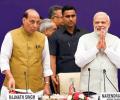
While the BJP has taken a beating, its leader still stands tall, points out T N Ninan.

'Milking poorly performing or easily marketable assets is the way to deliver more money for key programmes,' says T N Ninan.

Maruti, which is majority owned by Suzuki Motors of Japan, pays massive tax, generates huge employment (its staff are almost entirely Indians) and also makes its investors extremely rich. JLR, on the other hand, though owned by Tata has its factories in England and China and in every way (sales, employment, technology) has nothing Indian about it.

'Banks, fund managers, NBFCs, rating agencies, those buying into debt funds -- all of them will have to watch their step as India's financial system enters a new phase,' warns T N Ninan.

'No other language can now take its place. English is the language of professional education, which gives you a passport to a bright future,' says T N Ninan.

That is the number for job creation that India needs to achieve, argues T N Ninan.

'While we may aspire to be a democratic if smaller version of China, we may only manage to become a larger, more accomplished Indonesia,' says T N Ninan.
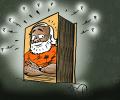
'In macroeconomic policy, timing is all, and by leaving things too late, Mr Modi may have made around 50 seats in the Lok Sabha highly vulnerable,' says T C A Srinivasa Raghavan.
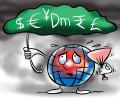
'An upswing in corporate performance should last at least three years.' 'Today there is some concern globally about excessive debt, which could cause unpredictable shocks down the road.' 'Domestically, if the minders of the economy are watchful about over-heating, we could avoid a repetition of the boom-bust cycle of the past,' says T N Ninan.

'Clearly, the financial system is a drag on the economy and underlines the need for improving banking practice, regulation and oversight.' 'Without that, and an end to the cronyism that caused part of the problem, one can kiss goodbye to 8% growth,' warns T N Ninan.

A modern economy with strong global linkages must switch to million, billion and so on, says T N Ninan.

'There is merit in appointing people with ability and energy, then leaving them to do the job.' 'The Modi government would have had a better record if it had stuck to this formula from the beginning,' argues T N Ninan.

The problem is not GST itself, but the nature of an economy dominated by small businesses unable to cope with the complexities of the tax, points out T N Ninan.
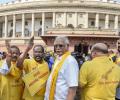
'Every Finance Commission creates its winners and losers' point out T N Ninan.

'The history of Moody's India ratings tells its own story,' points out T N Ninan.

'The only way to minimise logical inconsistencies and confusion is to develop the two rates of 12% and 18% as the ones that apply to almost all items.' 'At a later stage, these two rates could be merged into a single rate,' advises T N Ninan.

'We have here the world's largest economy and dominant superpower thrashing about as it wrestles with its own decline.' 'It has become everything that China was supposed to be: A threat to the world order, and as a country that is not playing by the rules on trade, on climate change, international commitments and nuclear deals,' says T N Ninan.

'Economically, if there are too many losers, macro-demand will suffer and undercut growth.' 'In more developed societies, the issue is resolved through the provision of safety nets, which don't exist in India.' points out T N Ninan.

'The Make in India target of getting manufacturing to account for 25% of GDP by 2022 is quite impossible to achieve.' 'As for the role of technology in the average Indian's life, it is still quite basic -- mobile phones and Mars successes notwithstanding,' says T N Ninan.
'The one sector where there is still a sense of crisis is banking, but the government has regrettably set its face against privatising any of the government-owned banks,' says T N Ninan.

'China has reclaimed, after two years, its mantle as the world's fastest-growing large economy.' 'This, when its working age population is shrinking, while ours is growing.' 'And talking of jobs, China expects to create 11 million urban jobs this year; for India, don't ask,' says T N Ninan.

If Mr Modi and his team expect to win the 2019 elections, groundwork for improved performance in their second term should be done now.

'The only credible explanation for the niggardly approach to defence expenditure must be that the government does not expect a war.' 'But wars can happen when you don't expect them, and re-arming at the last minute is not possible,' says T N Ninan.

'You have to hand it to Mukesh for sheer daring.' 'Who else in India would have sunk a stupendous $30 billion in a business that was yet to get a single customer?' 'With that, the older of the Ambani siblings has shown that he is in a class of his own,' says T N Ninan.

'There is economic danger: Not inflation, but a slowdown that feeds an employment crisis,' says T N Ninan.

'The estimates of tax forgone on this item run into hundreds of billions.' 'And there is neither fairness nor rationality to support continuing with this tax holiday for just one class of investors, those who put their money in shares,' says T N Ninan.

'While investors in Reliance have had to play a game of patience for long stretches, for Anil the challenge is to do what used to be his brother's forte -- generating cash by putting assets in the ground and making things,' says T N Ninan.

'If the Opposition believes the BJP is out to undermine the principles on which the Constitution rests, they had better start behaving as though they believe in those principles,' says T N Ninan.

'At least three top bureaucrats have been declared guilty in recent years in connection with scams where they had no pecuniary benefit.' 'But in the telecom case, a money trail is declared irrelevant because no scam has been proved in the first place.' 'Fair enough; so we must punish illegality without criminality, but ignore possible criminality as suggestive of illegality,' points out T N Ninan.

'The two-word answer is: Proper oversight,' says T N Ninan.

New body to replace Plan panel might retain 40% of existing staff

'The Chinese have taken to telling their Indian interlocutors to bear in mind the 5:1 disparity in the sizes of the two economies.' 'The message from Beijing, says T N Ninan, is clear: Acknowledge superior Chinese power, and behave accordingly.'
Experts will give their inputs for Budget.

The shift from 'one country, one tax' to four tax rates could dilute possible gains on GDP, warns T N Ninan.
The Modi government's record on governance is better than that of UPA-2, but not better than UPA-1, observes T N Ninan.

If Modi wants to be a man of history, he must make hard choices that will pay off down the road, says T N Ninan.

There is merit in considering whether merchandise exports can be facilitated by halting if not reversing the rupee's appreciation, says T N Ninan.
A new study shows that the bottom half of the population enjoyed only 15 per cent of national income in 2013-14, down sharply from 24 per cent in the early 1980s.

In a sharp attack on the Narendra Modi government, BJP leader Arun Shourie on Monday contended that it believes that managing economy means "managing the headlines" and that people had started recalling the days of former Prime Minister Manmohan Singh.

A more effective promotion of domestic manufacturing and mining could significantly reduce the trade deficit in key sectors, says T N Ninan.
